

It might seem like the Christmas period is still far away, because autumn hasn’t even really started yet. However, logistics companies invite you to start thinking about preparing for Christmas early this year. As the saying goes, “the slower you go, the farther you go” is very relevant to the preparation stage. Whether you’re a logistics specialist or a manager in a business, you need to be aware that there are various risks in the run-up to Christmas that could make it difficult for your business to receive a shipment on time. In the article, we explain the main recommendations so that the preparation for Christmas in your company goes without worries.
MyDello takes the stress out of global shipping. Instantly compare options across hundreds of shipping providers to find the best possible solution for your shipping needs. Visit MyDello to get an instant quote.
Christmas is only a few months away. Logistics specialists strongly recommend to act in time if you want to stock your online store or physical store shelves with various goods for the Christmas season. First of all, in the fall, various popular countries, such as the USA, Canada or China, may impose new restrictions due to the spread of the virus, and as a result, the time of receiving goods may be significantly extended. Observing the current situation in the field of logistics, businessmen are invited to use sea transportation from China to Europe, because currently price changes differ depending on the route, but in popular Far Eastern directions, the price difference reaches up to 40%.
Create Your No-Cost Account Today and experience the New Era of Logistics
Second, there is a labor shortage in many countries, especially in the US and Europe. Thirdly, the workers of several airlines are on strike for a long time. People’s expenses are growing disproportionately to income, so strikes are really expected more and more. They usually take place directly in large companies, such as Lufthansa, SAS, Hamburg port terminals, where there are large unions that are ready to fight for fair wages. Logistics specialists anticipate strikes in other companies related to international transport as well.
This type of force majeure will significantly affect the processing of cargo before dispatch and will prolong the delivery. That is why the cargo should be ordered already in September. Regardless of whether you, as an entrepreneur, this Christmas will be only the first or already the tenth, we invite all entrepreneurs to act in time and order cargo without worries. Using MyDello, it is possible to save both your time and costs by 15-20%.
Every year on the last Friday of November, the popular “Black Friday” sale takes place in several countries, forcing a number of retailers to prepare even faster for the sales boom. According to the long-term experience of logistics specialists, a high demand for air transportation can be observed in the month of November, because it is a relatively fast delivery time – during this period, transportation costs can rise rapidly, because in November businessmen will “fight” with each other to place their cargo on the cargo plane.
Given the above, the US and China may potentially be the countries that could significantly impact freight flow and delivery times. Why is this important? If there are significant developments in one or the other country, you have alternatives – a member state of the European Union, from which it is possible to order, for example, strings of Christmas lights or Christmas trees.
Cargo planning needs to be thought about much faster, because no one in China has so far canceled the policy of zero cases of Covid-19, which is implemented with the highest responsibility. If new outbreaks of the virus are recorded among the population, all businesses in the area are severely restricted or even suspended. Neither production nor transport or transport infrastructure companies (ports, airports) are exceptions. As a result, overloads are formed in the non-closed transportation nodes, because loads from the closed sections are transferred there.
Entrepreneurs are invited to evaluate – the closer to the end of the year, as there are greater risks related to both Covid-19 and airline employee strikes. It is very likely that no one will be able to avoid these risks, so it is more and more important to implement cargo planning now.
Create Your No-Cost Account Today and experience the New Era of Logistics
Regardless of whether you are a representative of a small, medium or large company and with or without a logistics specialist in your team, one of the most effective solutions for ordering cargo is the through MyDello. The platform will significantly facilitate your freight orders, allow you to easily review and compare the costs of freight shipments, as well as track the shipment 24/7. MyDello is staffed by experienced logistics specialists from Latvia, Estonia and Lithuania and will be able to find the best solution for you in different situations individually. The online platform is free to use. One platform, all freight modes, instant quotes. Find out more.
Follow MyDello news on ” LinkedIn ” and ” Facebook “.
Every year autumn highlights new topics to discuss and new challenges to tackle. And this time it still includes COVID. We are already witnessing new local lockdowns in China and we also see the transport volumes for pandemic-related commodities like protective gear and COVID tests are increasing again. A new wave is coming, but this time the world is well prepared to handle it.
China has always practiced more strict measures to fight the pandemics. At this time China is implementing local lockdowns if number of cases rises in one specific city or region. These lockdowns may be in place from a couple of days up to 10 days, depending on the number of new daily cases.
MyDello takes the stress out of global shipping. Instantly compare options across hundreds of shipping providers to find the best possible solution for your shipping needs. Visit MyDello to get an instant quote.
Create Your No-Cost Account Today and experience the New Era of Logistics
Logistics is not shut down during lockdowns. But safety precautions are applied. This is a big difference and it helps to keep goods moving and business going. This means that pick-up and deliveries can be done, but it may take an additional day or two due as in some regions a permit must be applied and in some cases decontamination process for the shipment and the truck may be needed.
Even now space for freight is easily available for air and ocean freight, with attractive rates too. If you are looking something faster than ocean transport, but cheaper than air freight and you do not wish to take risk with rail, our Ocean Premium service is a great option with 45-day transit time.
We decided to ask some of MyDello’s customers for their feedback to know why they use MyDello and whether they would recommend it to another. Or even to their competitors?
The companies that use the logistics service pointed out that MyDello is simple and logical because inquiries are held on one platform. There is no need to send out any email. “There is usually some important information missing in the emails. MyDello has the option to enter the data, and the offers will come immediately,” says Marite Uustal of beauty products company Careria.
Companies using MyDello, on average, spend 45% less time on logistics. It means there is more time to focus on the company’s core business and grow it. It’s also one of the main reasons Careria started using MyDello. “Simply enter the data and get the offers. You’ll know the best prices in less than a minute, and you’ll order the transport of goods in just a few clicks,” says Uustal.
You only need to know where from and to you want the shipment to be sent and what’s the dimensions estimate and MyDello will give you the first quote.
Create Your No-Cost Account Today and experience the New Era of Logistics
Which mode of transport to choose? Air, rail, maritime transport or road transport? As a platform, MyDello offers a wide range of services and helps you find a suitable, cost-effective solution.
Our client Tiia Prous from Kinkston confirms that. “So far, my experience has shown that the MyDello solutions are sufficient and can be safely used, whether the shipment is coming from Europe or Asia.”
Who would have thought that, in some cases, air transport could be faster and cheaper than by rail? This can sometimes happen, and so it is always a good idea to have the offer from different carriers and compare different modes of transport. You’ll get all these offers from MyDello in just a matter of seconds. MyDello statistics also confirm this—platform users spend 7-11% less money compared to traditional offerings. So, using MyDello, you win time and money.
Many companies, especially smaller ones, need logistics services a couple of times a month. Thus, knowing all the crucial things in the logistics world is sometimes difficult. MyDello platform helps make the right choices during the order submission process. If necessary, questions can always be addressed to MyDello’s logistics specialists.
Logistics is an area that requires day-to-day work and focuses on the details. MyDello’s team has experience and expertise in solving the most complex and time-critical situations. According to Peeter Vahar, Chief Experience Officer of MyDello, a solution to all the questions will be found. “Support is always available—for simple questions to the most complex cases,” Vahar says. The logistics specialists can always be contacted from the right corner of the MyDello page.
The use of MyDello is simple, and its functionalities support handling a single shipment and regular logistics work. The logistics specialist of Cleveron, Rasmus Kodres, couldn’t agree more. “Digital solutions are the next likely step in supply chain management, and platforms like MyDello that allow this are very much expected,” says Kodres. “Logistics is an area that requires exceptional accuracy. All the shipments and documents must be properly formulated and always within reach.”
The platform can track the current status of all shipments. In addition, you can, for example, see information about previously sent items or create reports about shipments. Explore the full functionality of the platform on the MyDello page.
Create Your No-Cost Account Today and experience the New Era of Logistics
MyDello started exactly one year ago on 26 April 2021, and the goal remains the same – we want future logistics to be fully automated. Over the year, it has become clear that our customers appreciate the possibility of comparing different modes of transport. As all costs increase, it is good to know that, on average, MyDello users save 15-20% on logistics.
MyDello is created by experienced experts from the field of logistics. MyDello is the most convenient way to get an immediate offer for international transport instead of many phone calls and emails. The portal displays a selection to find the most suitable transport solution for your business, taking changing circumstances into account.
Create Your No-Cost Account Today and experience the New Era of Logistics
We believe that global logistics will become fully automated in the near future. MyDello combines the various parties in the supply chain: we reduce the number of intermediaries, digitalise all information, and contribute to ensuring that the costs to logistics are minimal. According to our data, using the platform means 15-20% lower costs on average, and our customers value it highly.
MyDello’s primary goal is to provide a simple solution that a logistics specialist can handle daily. There have been major changes in logistics in the last two years due to the pandemic Covid-19 and crises, and companies are looking for new ways to operate as efficiently as possible. Compared to different supply modes, it is necessary to find the best solution. For example, during the crisis in the Suez Canal, maritime transport was disrupted, and prices increased rapidly. Which delivery method to choose as a replacement? The answer is just a few clicks away.
The best part of digitalisation is that the business is more efficient and takes less time. MyDello uses different logistics service providers and carriers and brings them all together. A good overview can already be obtained with a single query. Paperless management has become more natural in every sector and country. Therefore it’s great to witness the logistics sector coming more and more digital.
MyDello has countless advantages as a digital platform. Let the numbers speak for themselves: almost 2,000 companies have joined MyDello in the year. According to the latest feedback, customers appreciate the most important way to compare prices and delivery methods.
The whole logistics sector has changed significantly over the last year. Nevertheless, MyDello’s first year has been very successful. The main objective, to provide services with a turnover of at least two million euros, has been achieved. Two thousand customers have joined the portal, indicating a need for a digitalised logistics service.
MyDello is currently available in Estonia, Latvia, and Lithuania. Still, we plan to continue growing and soon start offering services to Swedish companies.
Create Your No-Cost Account Today and experience the New Era of Logistics
Follow MyDello also on LinkedIn and Facebook.
When sending goods and selecting pallet type and packaging materials, it’s best to be careful as the wrong choice may cause additional time and be more expensive. Requirements differ according to the goods, mode of transportation and desired destination, says Peeter Vahar, the Chief Experience Officer of MyDello.
In the EU, the most common pallet is EUR (the same size as ISO1). Usually, this helps to send goods almost everywhere without any extra hustle in the customs of the country of destination. The general rule is that even if the buyer takes care of the whole logistics, it is still the consignor’s responsibility to make sure that packaging and the preparation of the invoice are done correctly. It becomes natural when sending goods more often as there are some potential risks, mainly if exporting out of Europe.
MyDello takes the stress out of global shipping. One platform, all freight modes, instant quotes. Find out more.
Create Your No-Cost Account Today and experience the New Era of Logistics
The main rule for international trade is that all wooden pallets and materials must be treated against pesticides and pests. Processing the wood will help prevent the arrival and spread of potentially dangerous pests in the country of destination. Suitable pallets are already pre-ready and heat-treated or have to go under the fumigation process in the port.
Also, it is good to know that all wooden parts that are used for packing or fastening the goods must be fumigated. Just an example: there is a machine that exceeds the standard size, and there are pretty no pre-made suitable packages for that. In this case, it is still necessary to secure the shipment by using different packing materials and, most probably, some wooden pieces. When using wood, it’s good to select pre-treated components or the load must be fumigated before leaving the port. Fumigating before the transportation adds extra two or three days and a certificate will be issued after the process.
In addition to wooden pallets, there are also pallets made out of plastic and metal. In terms of price and quality, the most reasonable choice is wood. The advantage of plastic is that, unlike wood, it doesn’t rot. At the same time, transport is generally in dry conditions and, for example, in a container, excessive moisture does not endanger wood.
The choice of the pallet must primarily be based on the size and nature of the goods. In different countries and regions, there are different standards for the dimensions.
Packaging requirements apply to goods that may pose a higher risk to other goods, means of transport, persons or the environment in the transportation process. These requirements are regulated in international agreements. According to the type of risk, the requirements differ. For example, chemicals must be packaged in a box that withstands falls and leaks.
Suppose the goods are packed in accordance with the requirements. In that case, the transportation process does not differ, just some additional information must be provided on the goods, and the potential risks have to be avoided. However, it should be kept in mind that certain goods are subject to requirements that exclude, for example, transport in a passenger plane. For example, lithium batteries are generally only allowed to be transported in commercial aircraft.
If you should choose the wrong pallet or package, it probably causes some unwanted problems. Based on our experience, it is the cheapest to avoid mistakes beforehand instead of finding a solution with the customs board and the receiver afterwards. In the worst-case scenario, a wrong pallet or an error in choosing the right packaging materials may mean that the whole shipment will be confiscated. The process following the mistake generally depends on the rules of a particular country and customs, but sometimes it can be solved by simply changing unsuitable packaging. However, the customs procedure and the deposit may cause additional costs.
There have also been situations where the customs authorities do not agree to destroy nonfumigated pallets in more complex cases. In this case, the sender must pay to ship goods back to the sender. However weird it may be, an empty pallet must be shipped to the other side of the world. Usually, it is not seen as a big problem, but it sure costs extra money and time. You can be pretty sure that the delivery partner is not happy with the delays in the transportation.
If it’s your first time sending goods somewhere far away, or you want to double-check, feel free to contact MyDello. We will identify the specific conditions and the requirements. When sending dangerous goods, our system does not automatically display the price, but we will manually check the transport compliance before you can even notice.
Create Your No-Cost Account Today and experience the New Era of Logistics
We all need a little advice sometimes, especially in an industry as complex as logistics, give us a call and benefit from MyDello’s years of experience.
The airspace of Ukraine is closed to any commercial traffic. European airspace is closed for all Russian airlines. As a countermeasure Russian and Belarusian airspace is closed for European airlines. As a result, flights between Europe and Asia have been disrupted as European airlines need to fly longer routes now to avoid Russian airspace. A flight between Tokyo and Helsinki used to take 9 hours, but the adjusted route adds 4 hours of flying time now. Routes between Europe and China make a 3 hours detour on average.
Russian airlines, like Air Bridge Cargo which operated a significant amount of cargo flights between Europe and Asia, are banned to operate in European Union. After numerous cancellations and rearrangements, European carriers have managed to reestablish regular service between Europe and Asia amid the restrictions.
Create Your No-Cost Account Today and experience the New Era of Logistics
Although Russian Railways has been added to the list of sanctioned companies, it is still possible to keep goods moving on rail from China to Europe via Russia and Belarus. It is important to keep in mind the high risks involved. Risks related to both the war situation and any potential political decisions between the EU, Russia and China can have an unexpected result for cargo on the way under not being able to enter the EU.
Most main ocean carriers have decided to stop serving Russian ports. Combined with thriving oil prices this affects freight rates. The long-term impact is yet to be seen as the market is still showing first reactions.
As Coronavirus has started to spread with increasing speed in China again. China’s government has locked down Shenzhen, a city of 17.5 million people to halt the Covid outbreak. This means that also production companies cannot produce the goods. So far shipments are moving without bigger delays, but still, the risk for hold-ups is increased.
The dynamics of this situation are changing fast. That’s why we are closely monitoring the situation and will report if there should be any changes or disruptions in our services. This is to ensure as smooth service as possible.
· Air freight. Service on the Asia-Europe trade lane is now recovering, but the impact of reorganizing routes and a huge increase in oil prices affects the rates. Air rates from China to Europe have increased on average by 140% over the last two weeks. For other lanes like between Europe and the Americas, there is no dramatic increase.
· Rail freight. Service on the China-Europe lane is operating with no noteworthy disruptions up to this time. Shipments on the way are moving as scheduled. From the current week, MyDello resumed accepting rail freight shipments from China to Europe.
· Ocean freight. Demand for ocean transport from Asia to Europe is increasing. This results in a longer waiting time between booking and vessel departure. As many ocean carriers have stopped serving Russian ports, the demand for feeder ships in the Baltic has dropped, which may result in a less frequent feeder schedule to Baltic ports.
More updates to come in the upcoming days.
Need advice? – Feel free to get in touch and let’s discuss how we can help your business.
Create Your No-Cost Account Today and experience the New Era of Logistics
Shipping hazardous and dangerous goods around the world is not impossible and uncommon – it just involves more regulations and requires a bit more preparation than shipping regular goods. What is needed to make your dangerous shipments move smoothly and eliminate as many hassles as possible?
Dangerous or hazardous goods are substances that when transported are a risk to health, safety, property or the environment. By identifying dangerous and hazardous goods you are taking the first step in order to reduce the risks connected. Further steps include proper packaging, handling and transportation.
MyDello takes the stress out of global shipping. Instantly compare options across hundreds of shipping providers to find the best possible solution for your shipping needs. Visit MyDello to get an instant quote.
Create Your No-Cost Account Today and experience the New Era of Logistics
A good starting point for determining if your products might be dangerous is by obtaining a Material Safety Data Sheet (MSDS) from the manufacturer and checking the “Transportation Information.” By doing so, you will receive valuable information on the risks related to handling the products you are shipping.
Dangerous and hazardous goods are divided into nine classes that describe different types of risks.
Class 1 items are divided into six subdivisions that describe the potential hazard posed by the explosive. They cover substances that have an explosion hazard, explosions that may project fragments and firebrands, and fire hazards. The movement of class 1 materials is tightly regulated.
Class 2 items include all gases which are compressed and stored for transportation and are divided into three divisions: Flammable (also called combustible), Non-Flammable/Non-Poisonous, and Poisonous. This classification is based on the United Nations Recommendations on the Transport of these Goods – Model Regulations.
Class 3 comprises liquids or mixtures of liquids that have a flash point of not more than 60 °C (140 °F), or any material in a liquid phase with a flash point at or above 37.8 °C (100 °F) that is intentionally heated and offered for transportation or transported at or above its flash point in bulk packaging. The flash point is the minimum temperature at which a liquid gives off vapour within a test vessel in sufficient concentration to form an ignitable mixture with air near the surface of the liquid.
Flammable solids are any materials in the solid phase of matter that can readily undergo combustion in the presence of a source of ignition under standard circumstances, i.e. without Flammable solids are divided into three subdivisions that include highly flammable solids, solids that are likely to spontaneously and substances that, if they come into contact with water, emit flammable gases.
An oxidizer is a chemical that readily yields oxygen in reactions, thereby causing or enhancing combustion. This class is divided into two subdivisions and covers agents that react with oxygen and organic pesticides.
Poisonous material is a material, other than a gas, known to be so toxic to humans that it presents a health hazard during transportation. It is divided into two subdivisions and includes substances such as cyanide, arsenic, vaccines and pathology specimens.
Radioactive substances are materials that emit radiation.
Class 7 covers materials that have a specific activity greater than 70-kilo becquerels per kilogram.
A corrosive material is a liquid-or-solid material that causes full-thickness destruction of human skin at the site of contact within a specified period of time. Corrosive items include battery acids, sulfuric acid and mercury. When shipping corrosives, care should be taken to ensure that incompatible corrosive materials cannot become mixed, as many corrosives react very violently if mixed.
https://www.faa.gov/hazmat/what_is_hazmat/
A miscellaneous hazardous material is a material that presents a hazard during transportation but which does not meet the definition of any other hazard class. This class includes:
Note: Refer to the dangerous or hazardous goods transportation regulations of the country of interest.
https://www.chemsafetypro.com/Topics/TDG/Class_9_Goods.html
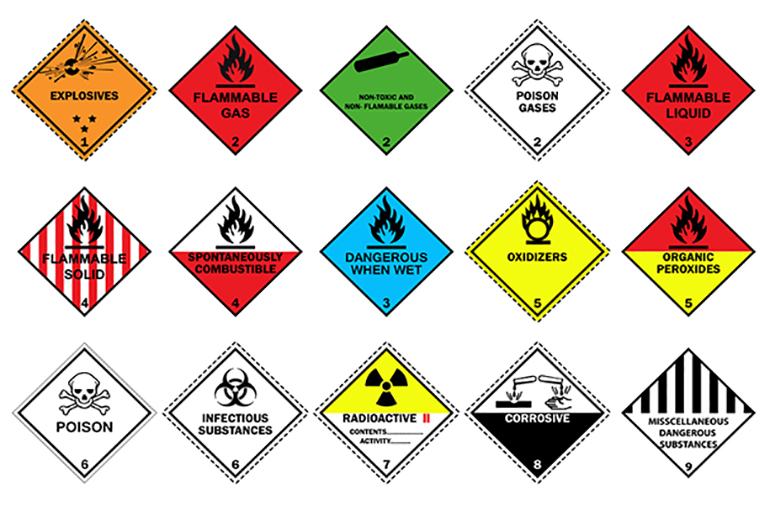
Goods that pose a possible risk have different rules when it comes to quantities. If you are shipping samples of any goods that might be considered dangerous, there are some options to move the goods in Excepted Quantities (no additional documents or full set of labels needed), Limited Quantities (labels, declarations needed, no certified packages needed) or Normal Quantities (Full set of documents, labels and packages needed). Shipping as small samples (Excepted or Limited Quantities) might give you an advantage in shipping costs and opportunities to move the goods. What is regarded as Excepted, Limited and Normal quantities might be depending on the certain classification of the dangerous or hazardous goods.
https://www.gov.uk/shipping-dangerous-goods/transporting-limited-quantities
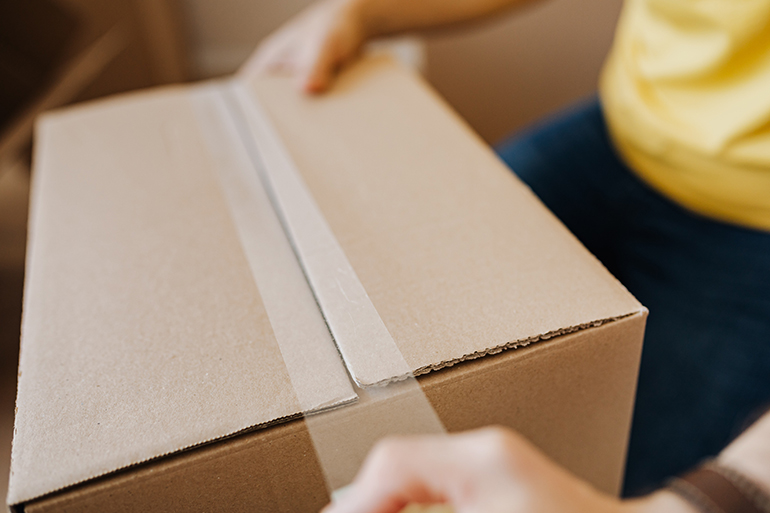
When dangerous goods are shipped, it requires proper packing. Some dangerous and hazardous goods require certified boxes and tapes that have proper markings. For example, regular plastic or painter’s tape might not be sufficient and armed tape is needed. In addition to packaging, proper labelling is needed. All boxes that contain these classification of goods need to have respective labels on them. Also, if the boxes are placed on a pallet and shrink-wrapped, additional labelling is needed on top of the shrink-wrap.
These goods require special safety-focused handling and transportation. Various regulatory authorities control the transportation of hazardous goods internationally and nationally. Some of the most common frameworks for transportation include the United Nations Recommendations on the Transport of Dangerous Goods, the IMO’s International Maritime Dangerous Goods Code, IATA’s Dangerous Goods Regulations and ICAO Technical Instructions.
Dangerous goods usually require a separate declaration, which describes the products in detail. Before filling out the declaration, make sure you consult with your forwarder or carrier. Responsibility for packaging and declarations is generally the shipper’s responsibility, but professional forwarders or advisors usually have experience and are able to help.
When the hazardous cargo is shipped the carriers will ask for a Material Safety Data Sheet, which is known as MSDS. This data sheet must contain full information regarding the product being shipped. MSDS is very important for the carriers to consider acceptance of the product onto the vessel. It basically provides the instructions and the full requirements for handling this dangerous cargo and it must be created by the manufacturer of the product as they would have full information on the item.
MSDS is intended to provide workers and emergency personnel with procedures for handling or working with that substance in a safe manner and includes information such as physical data (melting point, flash point, boiling point, etc.), disposal, toxicity, reactivity, health effects, first aid, protective equipment, and spill handling procedures. Most developed countries have similar regulations and requirements however MSDS formats can vary from source to source within a country depending on national requirements.
The International Civil Aviation Organization (ICAO)has developed dangerous goods regulations for air transport of hazardous materials that are based upon the UN model but modified to accommodate unique aspects of air transport. Individual airline and governmental requirements are incorporated with this by the International Air Transport Association to produce the widely used IATA Dangerous Goods Regulations (DGR).
https://www.iata.org/en/programs/cargo/dgr/faq/
Similarly, the International Maritime Organization (IMO) has developed the International Maritime Dangerous Goods Code (“IMDG Code”, part of the for transportation of dangerous goods by sea. IMO member countries have also developed the to provide compensation in case of spills in the sea.
The Intergovernmental Organisation for International Carriage by Rail (OTIF) has developed regulations concerning the International Carriage of Dangerous Goods by Rail (“RID”, part of the Convention concerning International Carriage by Rail. Many individual nations have also structured their transportation regulations to align with the UN Model in the organization as well as in specific requirements.
The Globally Harmonized System of Classification and Labelling of Chemicals (GHS) is the internationally agreed-upon system set to replace the various classification and labelling standards used in different countries. The GHS uses consistent criteria for classification and labelling on a global level.
We all need a little advice sometimes, especially in an industry as complex as logistics, give us a call and benefit from MyDello’s years of experience.
In general, shipping of these goods are more expensive and time-consuming. It’s reflected well in the shipping & packaging costs. Nevertheless, with proper planning and discussions with your forwarder, he or she can help you to make it happen – smoothly, safely and surely! MyDello logistics specialists can help you out.
The current situation between Ukraine and Russia is impacting everyone. This is a tragedy that will, first and foremost, cause great human suffering for Ukraine and the Ukrainian people. Recent days have brought decisions which among others are directly influencing international trade and global logistics.
Air traffic sees multiple restrictions. European Union has decided to ban all Russian-registered, Russian-owned or Russian-controlled aircraft from EU airspace. This means that mentioned aircraft cannot take off, land or overfly the territory of the EU.
An increasing number of EU air carriers are banned by Russian Federation or have chosen to avoid Russian airspace, which results in longer routings, extended transit times and higher costs between Asia and Europe.
Numerous sanctions have been established, which are impacting trade with partners in Russia and Belarus. Shipments with origin or destination in Russia or Belarus have restricted options.
Create Your No-Cost Account Today and experience the New Era of Logistics
During these hesitant times, changes can occur within hours. That’s why we are closely monitoring the situation and will report if there should be any changes or disruptions in our services. This is to ensure as smooth service as possible.
More news to come in the upcoming days.
Need advice? – Feel free to get in touch and let’s discuss how we can help your business.
Probably everyone is aware that China is the world’s biggest producer, it accomplished a total of $3.36 trillion in exports in 2021. Naturally, the largest import partner for Europe is China. But how do these goods arrive from China to Europe?
When people in Europe have a need for transportation from China, most probably they will think of two possible ways:
But are there any other transportation possibilities? – Yes, there are:
MyDello takes the stress out of global shipping. Instantly compare options across hundreds of shipping providers to find the best possible solution for your shipping needs. Visit MyDello to get an instant quote.
Create Your No-Cost Account Today and experience the New Era of Logistics
Since the launch of the first train on the China-Europe trade lane, it has seen at least double-digit growths year by year. There are many reasons for that, one of them being Covid 19 pandemic which caused global supply chain disruptions. Ocean freight experienced container shortage, but airfreight limited capacity due to numerous cancelled passenger flights. These conditions prompted supply chains to seek alternative transportation solutions.
Another reason for this growth is huge investments being done in rail infrastructure, where the biggest contributor is China. Rail freight is part of China’s New Silk Road, also called the “Belt and Road Initiative”, a mind-blowing $160 billion infrastructure development strategy. The objective of this strategy is to invest in nearly 70 countries and organizations to build infrastructure objects like ports, railroads, bridges, roads, airports, dams and tunnels.
The First China–Europe train was launched in 2011, that year accounted for 17 departed trains. In 2021 closed with a number of around 15000 departed trains – growth has been incredible. In January 2022 there was a significant moment of the 50,000th China-Europe train, beginning just around 10 years ago. Notwithstanding all this great progress rail freight is experiencing, it is still only around 3% of total China-Europe trade volume, however, it looks like its share is going to increase with years to come.
| Year | 2011 | 2012 | 2013 | 2014 | 2015 | 2016 | 2017 | 2018 | 2019 | 2020 | 2021 |
| Trains | 17 | 42 | 80 | 308 | 815 | 1792 | 3673 | 6376 | 8225 | 12405 | 15000 |
| Increase | 147% | 90% | 285% | 165% | 120% | 105% | 74% | 29% | 51% | 21% |
Table 1. The number of trains departed and year-over-year growth.
Rail freight services are as good as its weakest infrastructure element, so for 2022 industry experts are forecasting rail volume increase between 20-30% by improving border crossings, train speeds and connectivity between involved parties.
Create Your No-Cost Account Today and experience the New Era of Logistics
One of international rail transport’s biggest challenges is different rail gauge standards: China and most of the EU countries have a 1435mm standard, but Russia, Kazakhstan and other CIS countries use a 1520mm gauge standard.
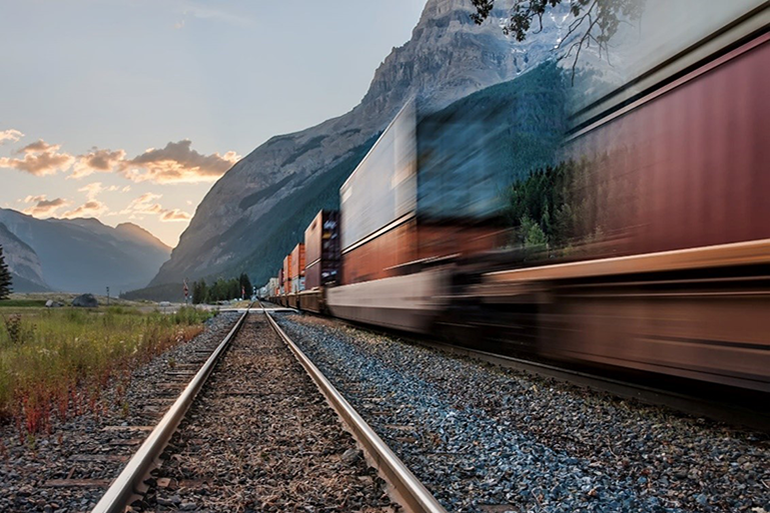
It was important to find good solutions to efficiently reload goods and help come up with ISO regulations for industry standards of 20-foot and 40-foot container types. 40-foot containers are being used the most for moving freight from China to Europe, and that has helped a lot to overcome different gauge standards and made it possible to reload containers on flatcars without opening containers. This improved reloading time at transhipment points, as well as the security of transported goods. More about containers here.
One 40’HC container has a capacity of 76,4 m3 and a payload slightly below 29 tons, however, maximum weight restrictions can vary depending on the carrier and local rules.
You shouldn’t worry if your shipment is not big enough to fill container space. Nowadays many freight forwarders are offering LCL (less-than-container load) services where containers are stuffed with multiple shipments and transportation costs are shared between parties. Such services are great for cost optimization and for environmental reasons, as it helps to avoid the transportation of half-empty containers.
There are two main rail routes in China:
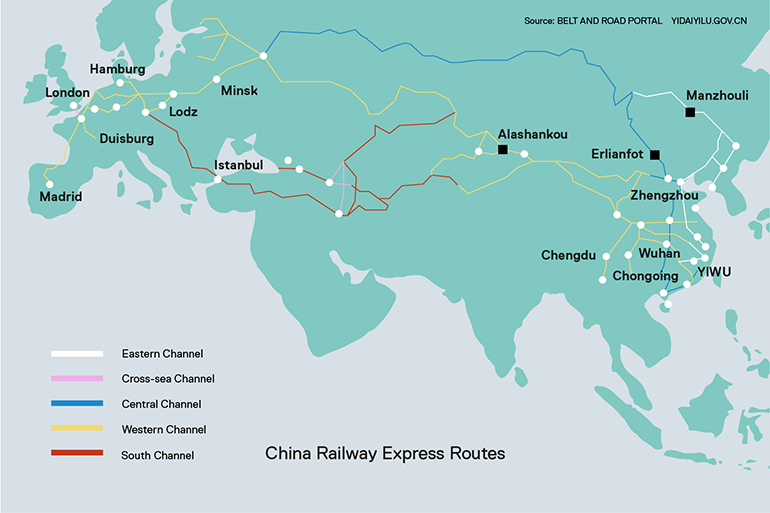
The biggest international rail hubs in China are Xi’`an, Chengdu, Chongqing, Zhengzhou and Urumqi. These five hubs are handling the absolute majority of China’s rail freight exports.
From the recipient side Duisburg and Hamburg in Germany and Malaszewicze in Poland are the biggest European hubs for China rail import handling, however with the development of the new Silk Road, there are many other participants who want to get a bigger piece of the pie.
Rail freight always goes hand in hand with trucking services for last-mile delivery, however, this is a common practice to use trucking services for connecting longer distances as well. For example, even though it is technically possible to move containers from China all the way to Baltics, in most cases such shipments are being arranged to Poland, Belarus or Russia and then trucked down to their destination in Baltics. Such a journey from terminal to terminal usually takes around 15-18 days, however, we also must consider the first available departure and cut-off times.
This is a common practice because of global transportation agreements between countries, also because of technical moments of multiple reloading and seeking for balance between transit time and the cost.
Create Your No-Cost Account Today and experience the New Era of Logistics
About three years ago around 80% of cargo used to be high-priced products like electronics, engineering products and car spare parts, however nowadays this group stands for only around 40% of total volume. Cheaper products like textiles, plastics, and rubber products are increasing their share, same as luxury goods.
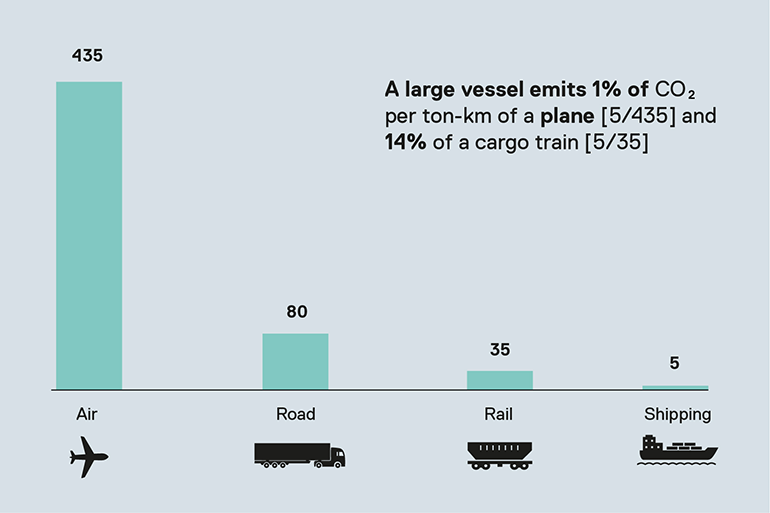
Because of different calculation methodologies used by different studies, CO2 numbers can differ a little per transportation mode, but the overall conclusion is there – rail transport is the second least environmentally harmful transportation mode.
International Maritime Organization study shows that rail transportation is having more than ten times less CO2 produced per ton-km compared to air transport, however, still produces around seven times more than the least environmentally impacting shipping by ocean.
One platform, all freight modes, instant quotes. Find out more.
It looks like railway transportation is getting a second breath and getting back World’s attention. It is well-forgotten gold that requires a bit of polishing to shine again. If set up well, it can be a good balance between transit time, cost and environmental impact which is getting more and more important. We think that railways as a solution for transportation will get used more and more for local and international freight but also for passenger movements.
Create Your No-Cost Account Today and experience the New Era of Logistics
If your business depends on shipping cargo, it is reasonable to take a moment and understand the main principles of cargo insurance and how your goods are protected against any unplanned events.
Anyone ordering transport for their goods is intending to get their cargo moved from shipper to consignee, without any delays, damage to the goods etc. In real life, it doesn’t matter whether your ship is by air freight, ocean containers or transport via rail, things sometimes happen even to the very best transport specialists. Anyone with experience in logistics can tell you that unforeseen events can turn your logistics upside down in a second. Unforeseen events can be transport delays caused by technical issues, weather or force majeure, but also related to mishandling, which may result in lost or damaged goods.
MyDello takes the stress out of global shipping. Instantly compare options across hundreds of shipping providers to find the best possible solution for your shipping needs.
Create Your No-Cost Account Today and experience the New Era of Logistics
This article will help you to learn more about cargo insurance, and how to protect your cargo and yourself against unpleasant surprises.
Every shipment which has been handed over to a freight forwarder is protected to some level by freight forwarders’ or carrier’s liability. It is important to keep in mind, that your freight forwarder or carrier can be held liable only in case the loss or damage occurs as a result of a mistake or negligence of a freight forwarder during transport.
In case any damage or loss has occurred in transit as a result of a mistake or negligence by your carrier of freight forwarder, your carrier is liable for the loss. Bear in mind there are limitations to the extent of liability, which deviates according to the transport mode used.
| Transport mode | Extent of liability | Standard conditions |
| Air freight | SDR 26.00 per kg | The Montreal Convention |
| Ocean freight | SDR 2.00 per kg | Hague–Visby Rules |
| Road freight | SDR 8.33 per kg | CMR Convention |
Table 1. Carrier’s maximum liability on different freight modes.
SDR or Special Drawing Rights was created as an international reserve asset by IMF. The value is linked to five currencies: the US dollar, euro, Chinese renminbi, Japanese yen and the British pound sterling. The current value of SDR on September 19th 2025 is 1.23 euros. Learn more about Special Drawing Rights here.
The International Chamber of Commerce (ICC) has introduced Incoterms to help standardize and simplify any international trade interactions involving in trade of goods. Today Incoterms 2020 is a set of standard terms used widely in international trade and the exchange of goods. Learn more about Incoterms on the webpage of the International Chamber of Commerce.
When shipping cargo Incoterms rules are there to help and define the rights and responsibilities of the buyer and the seller. These rules also help to define who is liable for any loss or damage occurring when the goods are in transit. Most common incoterms used for international trade:
More detailed information regarding incoterms can be found here.
Create Your No-Cost Account Today and experience the New Era of Logistics
Cargo Insurance is there to protect the owner of the goods from financial loss, which may occur due to damaged goods or loss of cargo. Cargo insurance for your shipment should be considered when the value of the goods shipped is higher than what the carrier’s liability would cover.
Cargo insurance is there to cover any damages to the shipments. This is intended to cover for example any scratched or dented items but also water damage.
When negotiating an insurance policy, you can also opt to insure potential loss of profit, which may occur due to an insurance event.
Insurance is only able to cover the damages if it can be proven that the shipper has packed the goods sufficiently and with suitable packaging. If the shipper hands the shipment over to the carrier without sufficient and secure packaging or with visible damage, it will be recorded by the carrier. However, if the consignee discovers any visual damage upon handover at the delivery place, the consignee will have to mark that down on the delivery receipt, as this will serve as evidence that the damage occurred while the shipment was in transit.
Cargo insurance also covers the loss of cargo in transit. If the consignee discovers during the handover of the shipment that some of the goods are missing, this needs to be noted on the transport document upon receipt, as this serves as evidence of the loss or theft has occurred during transportation.
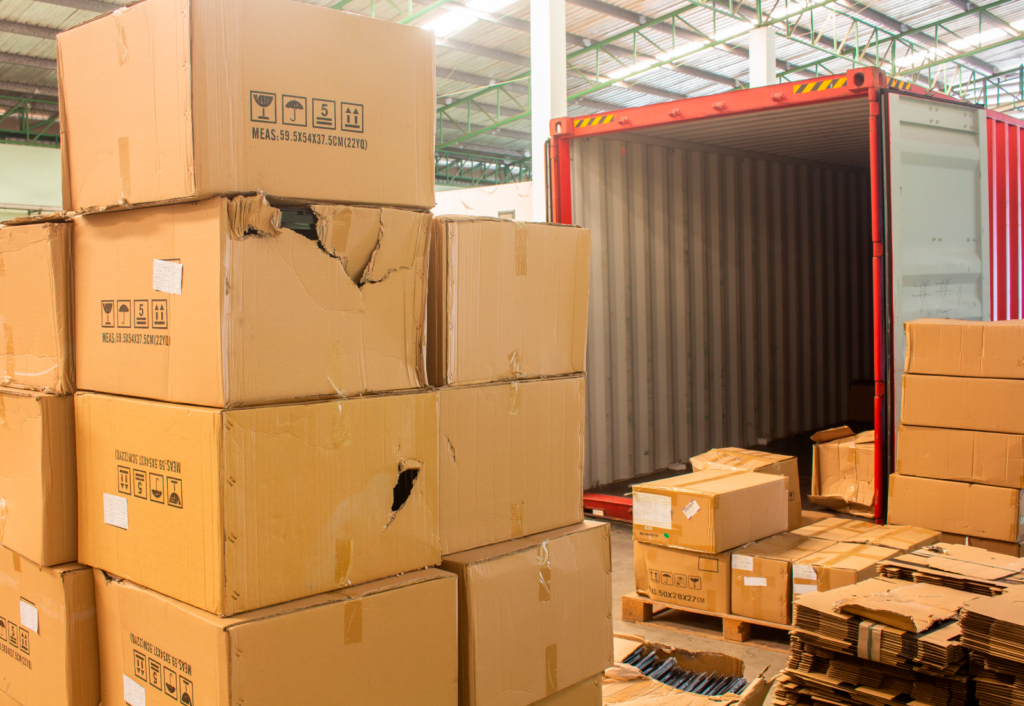
Below you can find the most common risks and measures which may affect your consignment when transporting.
If the shipper has handed the consignment over to the carrier with proper packaging and without any damage, yet the damage has been discovered by the consignee while receiving the shipment, the damage is covered by freight insurance.
In order to declare lost goods stolen, the theft must be demonstrable. In a case when upon receipt of goods it is discovered that some or all goods are missing, it needs to be noted on the transport documentation to prove that goods were lost while in the possession of the carrier. The burden of proving a theft lies on the party which was in possession of the shipment when the theft occurred. If theft cannot be proven, for example with CCTV recordings or otherwise, it will be treated as a loss.
Although your goods can be delivered without any loss or damage, it can be the case where a delayed delivery leads to consequential damage or financial loss. Usually, transit time is guaranteed only when using a premium service with a dedicated and guaranteed schedule. This means that in most cases transit time is not guaranteed, which results in carriers or forwarders not accepting any liability in case of damage created by a delay. However, in some cases, it is possible to insure yourself against potential consequential damage or special damage, to protect your finances and potential loss of profit.
The general average is used only in the maritime industry. It is a principle of collective share of any damages to a sea-going vessel, which jeopardises the ship, its crew and its cargo. The general average covers damages both to the ship and its cargo, but also any actions to protect the ship in danger or all costs of a salvage operation including the value of all goods that may have been sacrificed in the process. The general average is proportionally shared with the ship owners and cargo owners.
Although it is a rare event when a consignor sea freight needs to bear a part of the general average, cargo insurance usually covers this. Perhaps one of the latest cases General Average declared to by the owners of Ever Given blocking the Suess canal.
Create Your No-Cost Account Today and experience the New Era of Logistics
It does not matter if you have freight insurance or not, you should always present a claim to the carrier or freight forwarder first to hold them liable.
If your shipment has cargo insurance, you would file a claim with your insurer after you have held your carrier of freight forwarder liable. If the claim has been approved, your insurer will reimburse you according to the insurance policy and the insurer in turn will request the carrier or freight forwarder to pay out according to their liability regulated by applicable regulations.
We all need a little advice sometimes, especially in an industry as complex as logistics, give us a call and benefit from MyDello’s years of experience.