
Sign up for an absolute no-cost account and experience the future of logistics today.
Create Your Free Account!
Back

The different modes of transportation explained.

25-05-2026
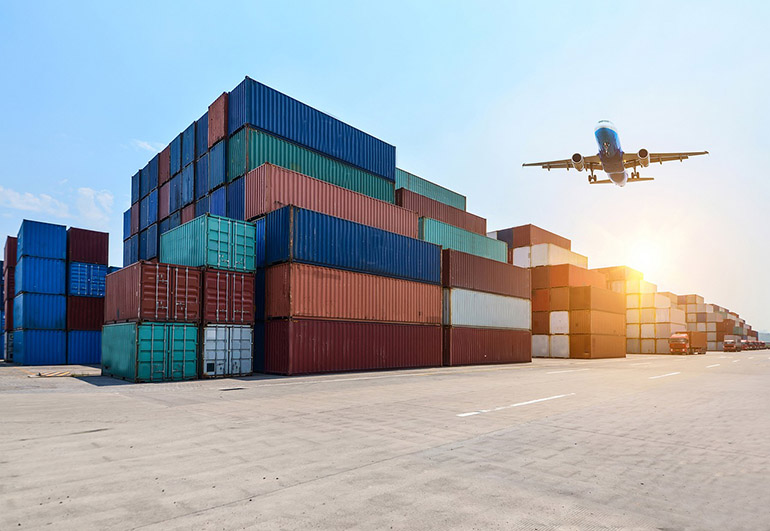
Airplane flying over container terminal

Usually there are several different modes of transport available, to move your shipment from origin to destination. Which one is the most suitable option for your shipment depends on, among other things, the options that are available for your route. In this article we will help you better understand the difference between the types of cargo transport modes, so you can make an informed decision for your supply chain. 


Besides the availability of transport options for your route, you also need to consider how quickly your shipment should arrive (transit time), what your budget for shipping is (transportation cost), the cargo value, and the measurements of the shipment.   

We all need a little advice sometimes, especially in an industry as complex as logistics, give us a call and benefit from MyDello’s years of experience.

What are the different types of cargo transport? 

There are 4 main transport type categories in global shipping: 

  • Air freight 
  • Ocean freight (or maritime transport) 
  • Road freight  
  • Rail freight. 

In addition, there is multimodal transport, which means combining several different shipping modes. 

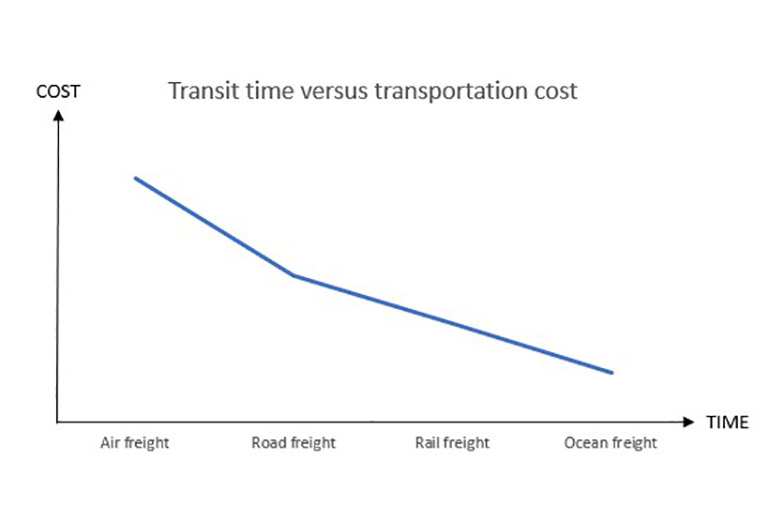
In general, you can say that air freight is the fastest and most expensive type of cargo shipping. For bigger cargo quantities, and where it is possible, ocean freight has the lowest shipping cost level, but it also takes the most time. Road freight and rail freight lie somewhere in between. Although trucking is the most flexible way of transport, for bigger and long-distance transport there are several benefits for rail freight.

Graph - transit time versus transportation cost
 Graph 1. The 4 modes of transportation: transit time versus transportation cost.

As things are not always so black and white,  we will give a more detailed overview of the transport modes in the next paragraphs.

Air freight

Air freight is the best transport mode for goods that require fast delivery and minimal inventory level. Half of the international air cargo is carried in the bellies of passenger aircraft and the other half with cargo freighters.

In air freight, depending on the operating aircraft, there are size and weight limitations for the shipments.

One of the disadvantages of air transport is its high CO2 emission per transported kg. It’s the highest compared to other transport modes.

Sometimes, on the way to the final destination airport, the shipments are moved between the middle airports by land (called road-feeder service) but are still considered as air cargo service.

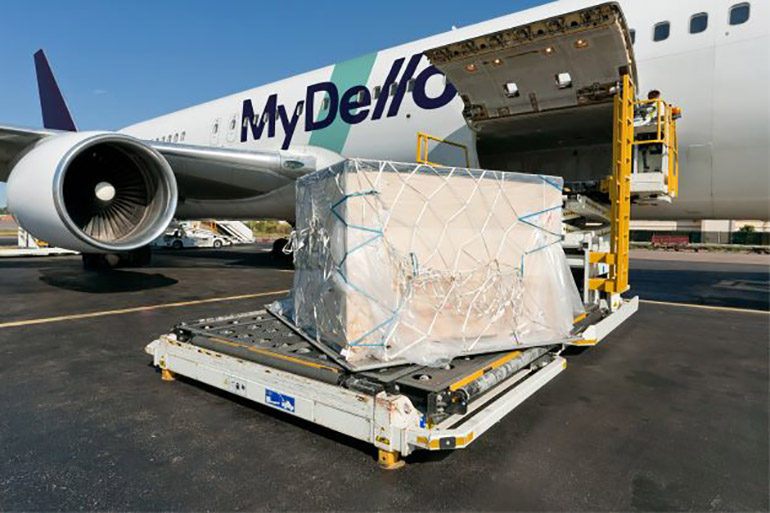
Loading cargo to airplane
Air freight – air cargo transport.

Benefits of air transport

Although air cargo makes up only a small portion of total international freight, it is an essential transport mode for many industries, such as high-tech, automotive, medical etc., where time-critical deliveries are needed.

Air transport:

  • is the fastest, but also the most expensive mode of shipping
  • has the fastest handling processes and documentation is quite well-structured, therefore takes less time
  • needs less handling and there is no need for heavy packaging

With air transport, you can ship your cargo basically anywhere, to most countries and territories in the World.

Ocean freight

Ocean freight is the main mode of transport for the global trade. It’s also called the lifeblood of global trade. Ocean transport is the best shipping mode for large cargo quantities, for very large cargo it is often the only option.

The biggest ocean container ships have the capacity to load more than 20 000 containers.

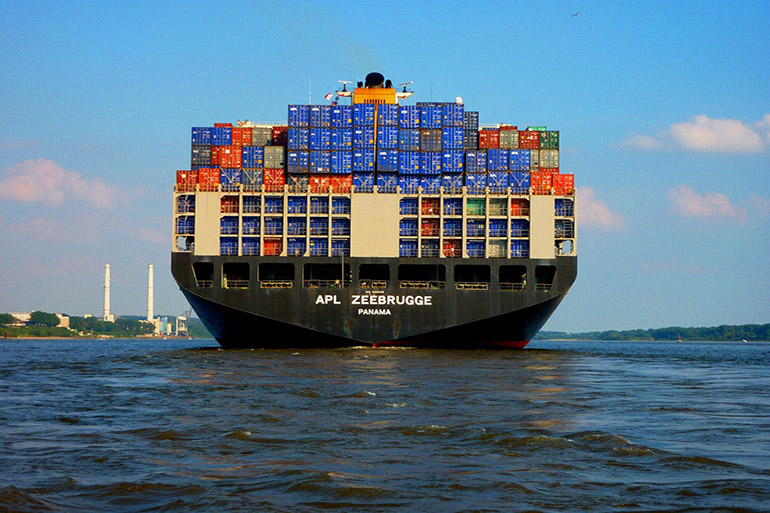
Big ship with with shipping containers
 Ocean freight – container ship with shipping containers. The most used modes of transportation.

Benefits of ocean transport

Ocean transport has the lowest cost per unit compared to other freight types, but it has also the longest transit time in most cases. Most of the low-cost bulk cargo, such as cereals, iron, coal etc., is moved by ocean freight. It is also the preferred mode of transport for high-volume and heavy cargo, such as minerals, metals etc., which are just not economically reasonable to move by air.

Ocean freight has the lowest environmental impact for shipped kg compared to other freight modes; therefore, many customers are preferring this.

In short, the main benefits of ocean freight are:

  • lowest cost
  • good for high-volume goods
  • most environment-friendly
  • good for a wide range of cargo

Most of the ocean cargo is shipped in containers. You can find more detailed info about the different container types and container dimensions on our resources page.

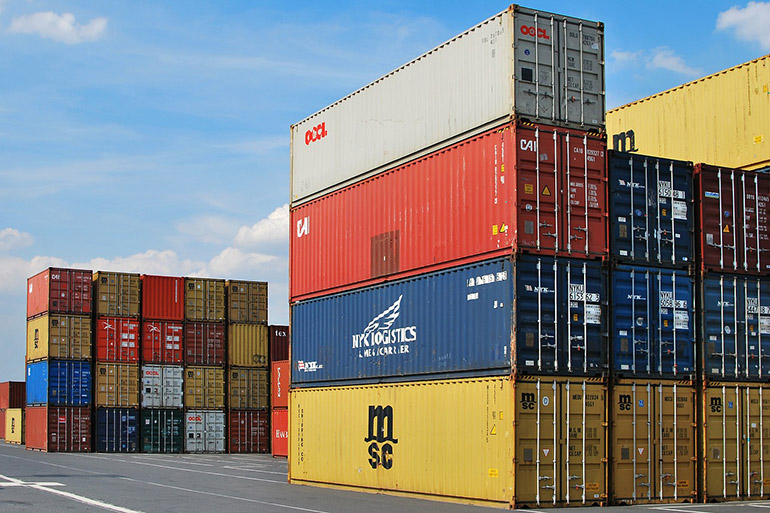
Colorful ocean containers at port
 Ocean containers – 40 ft standard container.

Full Container Load (FCL) and Less than Container Load (LCL)

Full Container Load (FCL) is an ocean freight shipment in which the cargo occupies a full container. So, FCL shipment is reasonable, if the cargo volume is big and takes most of the container capacity. If a customer is ordering the FCL shipment, in most cases, the empty container is delivered to the place of loading, where the shipper loads it with cargo.

Less than Container Load (LCL) is an ocean freight shipment wherein the shipper does not contract for a full container since the quantity of shipment is not enough for a full container, and the container is filled by multiple cargos from different shippers.

Using the MyDello platform you can easily sort and compare available LCL, FCL and other transport options by total transport cost or by transit time.

Road freight

Road freight is the most common mode of transport for intra-continent deliveries. For example, road freight makes about half of the total cargo deliveries inside Europe.

Sure, we also need to consider that for international air, rail and ocean deliveries, the pick-up from the place of loading to international air- or seaport is done by road transport. The same applies to the final delivery to the consignee location.

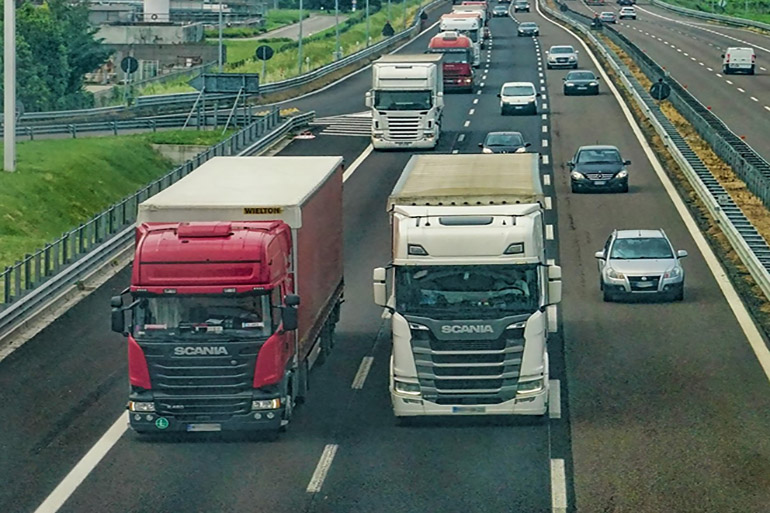
Trucks on the highway
 Road freight – trucks on the highway.

Benefits of road transport (or trucking)

Road freight is a quite flexible mode of transport that is also available in rural areas. However, its efficient operation can be affected by weather, road conditions and traffic.

Road transport:

  • Is the most cost-efficient mode of transport for short-distance deliveries.
  • Is relatively quick and has (for the most part) regular time schedules in place
  • Is well-regulated and the expected transit times are quite predictable in road transport.

Full Truck (FTL) and Less than Truck Load (LTL)

A regular trailer in Europe is 13.6 meters long and holds up to 33 EUR pallets. Like ocean freight shipments, trucking uses the full-load and part-load concepts.

Full Truck Load (FTL) is a road freight shipment in which the cargo occupies a full truck.

Less than Truck Load (LTL) is a road transport shipment wherein the shipper does not contract for a full truck since the quantity of shipment is not enough for a full trailer and the trailer is filled by multiple cargos from different shippers. LTL shipments can pass several terminals and different trucks on their way to the point of destination.

Rail freight

Historically rail freight has played an important role in international cargo deliveries. And although in recent decades its part in total global freight has reduced, Rail freight container delivers from China to Europe have shown a rapid increase since 2015 due to infrastructure development and expanded rail routes across Eurasia.

Compared to road freight, rail freight becomes more cost-efficient, especially for long-distance deliveries. One block train can have more than 100 wagons and only needs one driver.

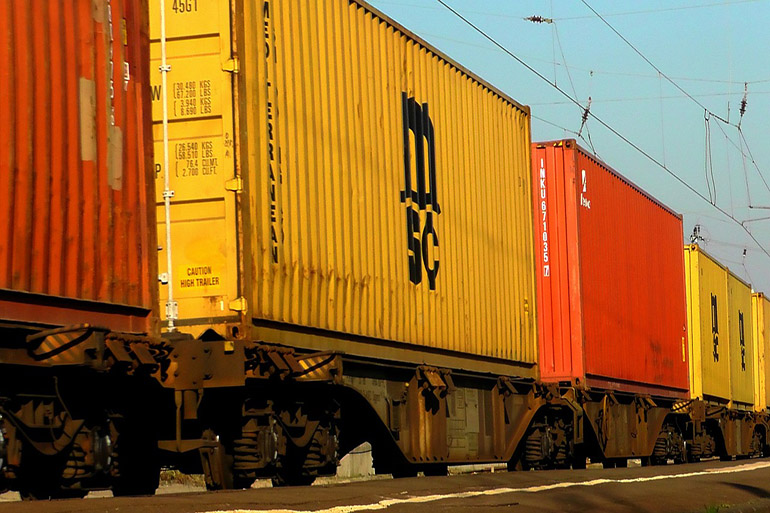
Containers on train
 Rail freight – container train.

Benefits of rail transport

For long-distance transportation, rail freight is one of the most environmentally friendly modes of transport. Rail transport is:

  • Relatively fast. For example, rail shipment from China to the EU takes about two times less time compared to ocean freight shipment.
  • In most cases, the rail freight is not affected by weather or traffic situation.
  • Rail has a strong safety record.


Multimodal transport

Multimodal transportation combines at least two different modes of transportation such as rail, ship, airplane and truck. For some routes, multimodal transport gives faster transit time or lower transportation costs.

Sometimes multimodal transport is the only way to move cargo to areas difficult to reach.

Rail freight and trucking combined transport

A good example is moving cargo out from China by rail freight up to Poland or Germany and then onforwarding from there by road freight to the final destination in Europe. This solution is about two times faster than ocean freight and has a significantly lower cost compared to air freight.

Sea freight and air freight combined transport (sea/air)

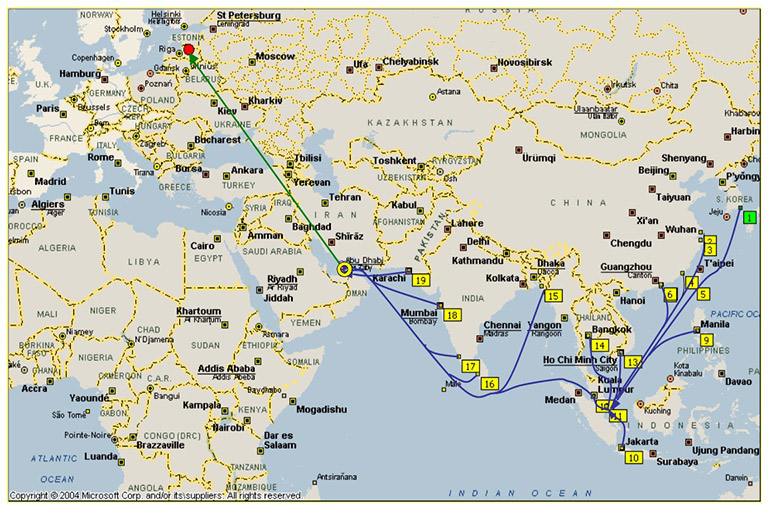
An example here is: sea/air transport solution shipments that move out from APAC ports by ocean freight up to Dubai, and from Dubai uplifted with air freight to Europe. This solution gives about 40% faster transit time compared to pure ocean freight but has a lower total transport cost compared to pure air freight. It is also more eco-friendly.

Map - sea-air service from APAC
 Sea-air service map – from APAC ports to Europe.

The most used modes of transport in global freight

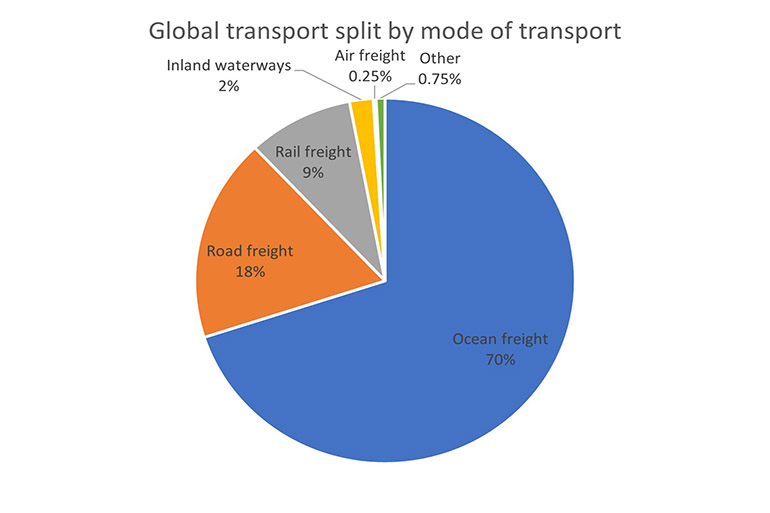
Data from 2015 show that 70% of global freight is shipped by ocean transport, 18% by road freight, 9% by rail, 2% by inland waterways and less than 0.25% by air. [source]

Graph of global transport split by freight mode.
  Graph 2 Global transport by freight mode.

The most used freight modes in the European Union

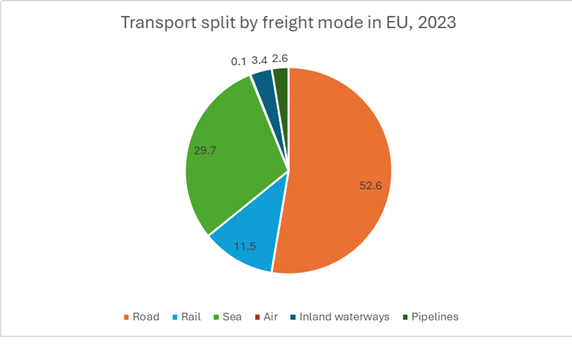
Inside the EU the split of transport modes used in 2023, was as follows:

  • Road transport – 52,6%,
  • Maritime transport – 29,7%,
  • Rail transport – 11,5%,
  • Inland waterways – 3,4%
  • Oil pipelines – 2,6%
  • Air transport – 0.1%

[source]

Transport split by freight mode in EU, 2023.
Graph 3 Transport split by freight mode in EU, 2023.

Conclusion

There are several options for moving your shipment from origin to destination. Each transport mode has its advantages and disadvantages and there are several factors to consider before making the final choice. Still, in general, the decision comes down to (1) what transport options are available, (2) how urgently you need the cargo at the destination and (3) what is your budget for shipping.

MyDello takes the stress out of global shipping. Understanding your shipment size can be difficult at the best of times, MyDello has built an online calculator to simplify this whole process.

Considering your shipment’s weight and dimensions, modern logistics platforms help you to make wiser decisions between different modes of transport on transit time and price scale.